Loading...
Home
About
Editorial Board
Journal Council
Instruction
Subscription
Advertising
Contact Us
中文
Instruction for Authors
Writing Guidance
Ethics Statement
Editor-in-Chief: DU Yanliang
Executive Deputy Editor-in-Chief: LI Shucai
Sponsor: Shandong University
Published by: Shandong University Press Co., Ltd.
Office Online
»
Online Submission
»
Copyright Transfer Agreement
»
Manuscript Template
»
Recommendation Letter
»
Authors Contribution Form
»
Statement of Competing Interests
Quick Search
GO
Advanced
Online Journal
»
Current Issue
»
Archive
»
Top Download
»
Top Read
WeChat
Table of Content
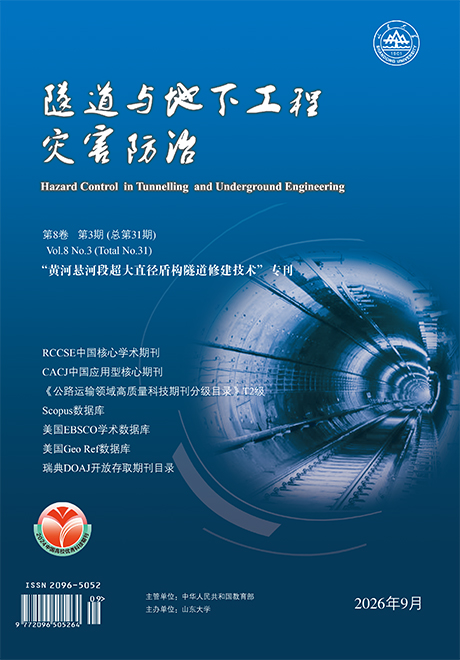
20 September 2026, Volume 8 Issue 3
Previous Issue
For Selected:
View Abstracts
Download Citations
EndNote
Reference Manager
ProCite
BibTeX
RefWorks
Toggle Thumbnails
Select
Key design techniques for highway-railway combined shield tunnels in the middle and lower reaches of the Yellow River
Collect
Sun Wenhao, Xu Weimin, He Yingdao, Li Penglin, Zhang Jincheng, Zhang Liangliang
Hazard Control in Tunnelling and Underground Engineering. 2026,
8
(3): 1-9. DOI:
10.19952/j.cnki.2096-5052.2026.03.01
Abstract
(
28
)
PDF
(13513KB) (
2
)
With the rollout of the Yellow River National Development Strategy, the demand for cross-Yellow River transportation infrastructure construction has continued to grow, and the construction and operation safety assurance of road-rail combined tunnels has been identified as a core technical challenge. In this research, a combination of model testing, numerical simulation and engineering analogy methods was adopted, and key design technologies and operation safety assurance schemes for the Jinan Jiluo Road Yellow River-Crossing Tunnel and its Northern Extension Project were systematically summarized. The results showed that: an innovative collaborative evacuation and integrated ventilation design was adopted, by which highly efficient utilization of cross-river channel resources and underground space was realized. A mechanical model for the "segment lining + internal structure" composite system was constructed, and a patented inter-ring shear-resistant structure and an integrated waterproof system for segment joints were developed, by which the safety factor of the segment lining structure was increased by 25.3%-33.6%. A quantitative correlation between segment lining damage area and flood control gate closing time was established. A prefabricated assembly scheme for tunnel internal structures was implemented, by which the construction efficiency of tunnel internal structures was improved while keeping the tunnel cross-sectional diameter under strict control. A real-time monitoring system for segment lining structures and an intelligent tunnel operation and maintenance management platform were built, by which the refined management level and traffic safety assurance capability during tunnel operation were significantly enhanced. It was concluded that the research findings could provide valuable technical reference for the design and construction of super-large diameter shield tunnel projects in the middle and lower reaches of the Yellow River, as well as similar large-scale river-crossing and sea-crossing infrastructure projects.
Select
Review of the research status of fire resistance technologies for tunnel lining structures
Collect
Xu Weimin, Zhang Shaoqi, Shen Yi, Yan Zhiguo
Hazard Control in Tunnelling and Underground Engineering. 2026,
8
(3): 10-22. DOI:
10.19952/j.cnki.2096-5052.2026.03.02
Abstract
(
23
)
PDF
(2872KB) (
1
)
To clarify the damage mechanisms and fire resistance performance of tunnel linings under fire exposure, recent research progress in fire resistance technologies for tunnel linings was systematically reviewed, aiming to provide a reference for fire-resistant design and safety assurance in tunnel engineering. Through a comprehensive analysis of relevant literature and engineering case studies, four key aspects were summarized: concrete spalling mechanisms under fire conditions, evolution of high-temperature performance of lining structures, characteristics and limitations of existing fire resistance measures, and future development trends. The analysis indicated that fire-induced concrete spalling was primarily attributed to the coupled effects of vapor pressure, thermal stress, and thermal cracking, while the high-temperature performance of linings exhibited significant thermal and mechanical degradation. In addition, traditional fire resistance measures, including passive fire protection, material modification, and structural reinforcement, were widely adopted but commonly suffered from poor durability, high maintenance costs, and a lack of synergy between fire resistance and load-bearing functions. Furthermore, two emerging technologies were highlighted: microencapsulated self-fire-resistant concrete, which achieved autonomous structural protection under fire conditions through the synergistic action of embedded microcapsules and hybrid fibers, and intelligent early warning and digital twin technology, which endowed linings with sensing and early warning capabilities through artificial intelligence and digital twins. These emerging technologies represented a new trend toward intelligent, self-protective, and integrated fire resistance strategies.
Select
Prediction of settlement during construction of twin large-diameter shield tunnels
Collect
Zhao Shichao, Wang Jianhong, Wang Chao, Lu Jialin, Du Changyan
Hazard Control in Tunnelling and Underground Engineering. 2026,
8
(3): 23-30. DOI:
10.19952/j.cnki.2096-5052.2026.03.03
Abstract
(
29
)
PDF
(9928KB) (
2
)
To investigate the construction settlement issue of a twin-tube, large-diameter slurry shield tunnel crossing beneath a railway embankment, and to explore the settlement and deformation patterns of the railway during the shield undercrossing process, relevant research was conducted based on the Northern Extension Project of the Jiluo Road Crossing the Yellow River Tunnel in Jinan. In terms of research methods, numerical simulation, theoretical analysis, and field monitoring were comprehensively utilized. The stress release method was adopted for the numerical analysis, and three working conditions with stress release rates of 15%, 20%, and 25% were established and analyzed. It was shown by the results that the railway settlement was generally positively correlated with the stress release rate; however, this correlation was weakened, and an opposite trend was even locally exhibited at the center of the railway. The ground settlement was observed to gradually accumulate throughout the entire process before and after the shield crossing, and the stage with the maximum settlement variation was observed between 10 and 20 rings before and after the shield passage. Furthermore, by establishing the relationship between stratum volume loss and stress release, the settlement patterns obtained by Peck's formula and numerical simulation were compared. It was found that the settlement prediction results obtained by numerical analysis were generally greater than those obtained from actual field monitoring. Based on the above results, it was concluded that the model and analysis method adopted in this study had a certain safety margin and could provide a powerful analytical tool for the safety prediction of settlement risks during large-diameter slurry shield construction.
Select
Research and validation of the intelligent disaster prevention system for the Jinan Yellow River Tunnel
Collect
Duan Yuexin, Chen Xin, Shen Yi, Zhang Yi, Yan Zhiguo
Hazard Control in Tunnelling and Underground Engineering. 2026,
8
(3): 31-44. DOI:
10.19952/j.cnki.2096-5052.2026.03.04
Abstract
(
28
)
PDF
(13045KB) (
1
)
An intelligent disaster prevention system for complex tunnel scenarios was developed to improve environmental perception, fire monitoring, situation reconstruction, and emergency evacuation in long underwater river-crossing tunnels. The system consisted of four functional modules: environmental-parameter perception, fire monitoring and early warning, fire situation reconstruction, and dynamic evacuation. Environmental monitoring and ventilation regulation were conducted using a fuzzy-control-based method. A GA-BP(genetic algorithm-backpropagation)neural network was employed for fire early warning through multi-source data fusion, while a long short-term memory(LSTM)network was used to predict the fire source location and heat release rate(HRR). A multi-agent model was introduced to generate dynamic evacuation strategies, with smoke propagation, visibility, toxic gases, and occupant movement characteristics taken into consideration.The proposed system was validated using the Jinan Yellow River Tunnel as the engineering background. The results showed that the fire warning model reached the warning criterion approximately 20 s earlier than the conventional temperature-difference threshold method. The LSTM model achieved coefficients of determination(
R
2
)of 95.9% and 93.7% for HRR prediction under complete data and partial high-temperature sensor failure conditions, respectively. The total evacuation time for 16 typical evacuation scenarios ranged from 654 to 780 s. The effectiveness of the proposed system in continuous and coordinated environmental perception, fire warning, situation reconstruction, and dynamic evacuation decision-making was demonstrated through the validation.The proposed framework was considered to provide an engineering reference for intelligent disaster prevention and emergency management in complex tunnels.
Select
Monitoring on segment convergence deformation of large-diameter shield tunnels based on real-time cyber-physics interaction
Collect
Chen Junwei, Shi Jiangjie, Quan Liangchen, Zhang Yu
Hazard Control in Tunnelling and Underground Engineering. 2026,
8
(3): 45-55. DOI:
10.19952/j.cnki.2096-5052.2026.03.05
Abstract
(
28
)
PDF
(12976KB) (
1
)
Tunnel structural deformation was defined to include not only geometric deformation, but also elastic deformation of segments and rigid deformation induced by joint opening. To ensure the construction safety of superlargediameter shield tunnels and to address the technical challenge that a single monitoring method could not balance realtime performance and accuracy, a segment deformation monitoring algorithm based on real-time interaction between software and hardware was proposed. Strain and rotation angle data were fused by Kalman filtering to obtain realtime absolute convergence information of segments. The proposed algorithm was applied to the Jinan Yellow River Tunnel Project and verified by laserscanning data. The results showed that the fusion algorithm could effectively suppress sensor noise, improve monitoring accuracy by over 30% compared to conventional methods, and achieve favorable realtime performance and stability. A new technical idea for deformation monitoring of large-diameter shield tunnels was thereby provided.
Select
Modified preparation, microscopic characterization, and performance regulation of shield muck-based ceramsite
Collect
Li Chunlin, Wang Jing, Xiong Yifan, Zhang Yaming, Yu Xiao, Jiang Hao, Zhang Yijie, Han Xuecheng
Hazard Control in Tunnelling and Underground Engineering. 2026,
8
(3): 56-65. DOI:
10.19952/j.cnki.2096-5052.2026.03.06
Abstract
(
30
)
PDF
(10018KB) (
1
)
The stockpiling of massive muck produced by shield tunnelling construction easily triggers a series of environmental and safety problems, including land resource occupation, dust pollution and slope sliding. Most existing studies on ceramsite prepared from shield tunnelling muck focus merely on single formulation schemes, while systematic analyses on the modification laws of different admixtures(e.g., fly ash and straw)and their microstructural regulation mechanisms are still insufficient. In this research, shield muck sourced from the Jiluo Road Yellow River Tunnel Project was adopted as the primary raw material. Fly ash and straw were separately incorporated as admixtures to fabricate three types of ceramsite, namely pure muck ceramsite, fly ash composite ceramsite and straw composite ceramsite. The effects of sintering temperature, holding time and material proportion on the key properties of the prepared ceramsite, including loss on ignition(LOI), bulk density and compressive strength, were systematically investigated,combined with scanning electron microscopy(SEM), energy dispersive spectroscopy(EDS)and nuclear magnetic resonance(NMR)pore tests, to reveal the internal correlation between the microstructural characteristics and macroscopic performance. The results showed that the pure muck ceramsite achieved the optimal compressive strength of 10.8 MPa at a sintering temperature of 1 100 ℃ with a particle size of no more than 10 mm. The fly ash composite ceramsite with a fly ash content of 50 wt% delivered excellent mechanical performance with a compressive strength of 18.2 MPa within the sintering temperature range of 900-1 100 ℃. In addition, the straw composite ceramsite with a straw content of 10 wt% could be successfully formed at a low temperature of 250 ℃ for a holding time of 20 min, with a water absorption rate of 27.69%. The three types of ceramsite exhibit distinctly different microstructures, which were characterized by dense structure, uniform cementitious structure and loose porous structure, respectively. The elemental composition was closely correlated with raw material components and sintering process parameters. This research provides a novel technical approach for the resource utilization of shield tunnelling muck.
Select
Research on calculation model of critical smoke control velocity for evacuation passages in shield tunnels
Collect
Luo Chiheng, Guo Yuanjun, Jia Yao, Jiang Xuepeng
Hazard Control in Tunnelling and Underground Engineering. 2026,
8
(3): 66-75. DOI:
10.19952/j.cnki.2096-5052.2026.03.07
Abstract
(
25
)
PDF
(10478KB) (
1
)
To determine the critical smoke control velocity for safety evacuation passageways located beneath the carriageway of shield tunnels, a theoretical model based on the Froude number was developed and validated via FDS(fire dynamics simulator)numerical simulations and reduced-scale experiments. An implicit governing equation for the critical smoke control velocity was theoretically derived by considering the effects of longitudinal tunnel velocity, fire heat release rate, and tunnel height. The results showed that the critical smoke control velocity decreased linearly with increasing longitudinal tunnel velocity, increased linearly with increasing fire heat release rate, and decreased exponentially with increasing tunnel height. Meanwhile, a critical Froude number of 12 was identified as the threshold for preventing smoke ingress into the safety evacuation passageway. The proposed theoretical model was further validated in a 1∶10 reduced-scale experiment, and the maximum absolute deviation between the calculated and measured velocities did not exceed 0.05 m/s, demonstrating the satisfactory predictive accuracy of the model. The results can provide a theoretical basis for the design of pressurized ventilation systems and the determination of critical smoke control velocities in safety evacuation passageways of shield tunnels.
Select
Deformation and damage evolution law of shield tunnels crossing soft-hard heterogeneous strata under additional loads
Collect
Zhou Peng
Hazard Control in Tunnelling and Underground Engineering. 2026,
8
(3): 76-88. DOI:
10.19952/j.cnki.2096-5052.2026.03.08
Abstract
(
23
)
PDF
(15060KB) (
1
)
To reveal the longitudinal mechanical response and damage evolution law of shield tunnels in soft-hard heterogeneous strata, a refined three-dimensional longitudinal numerical model was established based on the engineering background of the Jinan Yellow River Jiluo Road Tunnel. After an overall damage index for the tunnel lining was adopted, the deformation characteristics, damage evolution laws, and failure mechanisms of the tunnel under the additional loads induced by riverbed siltation were systematically investigated. In addition, parametric sensitivity analyses of the longitudinal residual jacking force and bolt diameter were carried out. The results indicated that significant longitudinal non-uniform deformation at the soft-hard stratum interface was induced by the bearing capacity difference between the soft and hard strata. Opening on the hard soil side and dislocation on the soft soil side were exhibited by the circumferential joints, and these structural deformations were aggravated as the additional loads increased. The soft-hard stratum interface was identified as the most sensitive zone for structural deformation and damage accumulation. The compressive damage of the lining was mainly concentrated at the stratum interface, while tensile damage was predominantly distributed on the soft soil side. The transverse deformation of segment rings was verified to be the key factor inducing tensile failure of the tunnel lining. The longitudinal stiffness of the tunnel could be improved by both the longitudinal residual jacking force and the bolt diameter, whereas distinct mechanisms of action on structural responses were observed. A more significant effect on deformation control and damage evolution was exerted by the longitudinal residual jacking force than by the bolt diameter. The longitudinal deformation and circumferential joint dislocation were found to be reduced by the longitudinal residual jacking force, whereas local compressive damage and tensile damage on the soft soil side were aggravated by it. By contrast, the transverse deformation of segments was effectively restrained, and tensile damage was reduced by the increase in bolt diameter. It was demonstrated that the soft-hard stratum interface was regarded as the critical position for the safety control of shield tunnel structures, and the longitudinal residual jacking force was identified as a vital factor affecting the structural stress state and damage development. A reliable reference for the design, construction, and operational safety assessment of shield tunnels in soft-hard heterogeneous strata could be provided by the research results.
Select
Lifecycle spatial effects of super-large diameter shield working shafts in silty clay strata in the middle and lower reaches of the Yellow River
Collect
Zhai Bin, Liu Yan, Liu Junting, Yuan Peng, Sun Feng, Wang Wei, Zhang Liangliang, Chen Fangyan
Hazard Control in Tunnelling and Underground Engineering. 2026,
8
(3): 89-101. DOI:
10.19952/j.cnki.2096-5052.2026.03.09
Abstract
(
23
)
PDF
(15203KB) (
1
)
To investigate the complex three-dimensional spatial effects of super large diameter shield working shafts in typical silty clay strata of the Yellow River basin, a deep foundation pit of a shield working shaft in Jinan along the Yellow River basin was taken as the engineering background. Numerical simulation and field monitoring were adopted to systematically study the influences of different length-to-width ratios and vertical installation positions of ring frame beams on the spatial effects of the foundation pit. The deformation characteristics of retaining walls and ground settlement patterns of the shield working shaft were revealed. The results show that the maximum horizontal displacement of retaining walls and ground settlement vary most significantly when the length-to-width ratio
L/B
of the working shaft is less than or equal to 2. When
L/B
>2, the deformations tend to be stable, and the maximum horizontal displacement hardly increases with the enlargement of the long-side dimension. Compared with the construction period, the position of the ring frame beam exerts a greater influence on the foundation pit during the service period. Installing the bottommost ring frame beam near the maximum deformation zone of the retaining wall can effectively improve the overall deformation control performance. The research findings can provide a theoretical basis and practical references for the design and construction of shield working shafts under similar geological conditions.
Select
Study on long-term settlement of shield tunnels parallelly undercutting existing highway tunnels with variable spacing under cyclic dynamic loading
Collect
He Jiacheng, Zhu Chi, Fu Jinyang, Sun Qianhui, Li Yanan
Hazard Control in Tunnelling and Underground Engineering. 2026,
8
(3): 102-114. DOI:
10.19952/j.cnki.2096-5052.2026.03.10
Abstract
(
23
)
PDF
(12621KB) (
1
)
To reveal the long-term settlement behaviour of an existing highway tunnel caused by a newly constructed shield tunnel passing beneath it in parallel under cyclic train loading, the Yellow River Crossing Tunnel of Jinan Rail Transit Line M2 was taken as the engineering background. Soil dynamic deformation parameters were obtained through laboratory dynamic triaxial tests, and a cumulative plastic deformation-based settlement model was established. Dynamic finite element simulations were then conducted to analyse the ground dynamic stress distribution and the long-term settlement response of the existing highway tunnel under different tunnel clear spacings. The results showed that the ground dynamic stress was mainly concentrated within 10 m beneath the newly constructed shield tunnel, accounting for approximately 60%~70% of the total dynamic stress variation. The settlement of the existing highway tunnel increased with tunnel spacing, while the contribution of vehicle dynamic loading first increased and then decreased. Based on multiple working conditions, a quantitative relationship between tunnel clear spacing and long-term settlement was fitted. The proposed model and fitted formula reflected the controlling effect of tunnel spacing on long-term settlement and provided a targeted method for settlement prediction and safety assessment in similar shield tunnelling undercrossing projects.
Select
Research on intelligent prediction of surface deformation induced by super-large diameter shield tunneling in silty clay ground
Collect
Zhong Jianmin, Zhang Xiaoping, Zhang Liangliang, Wu Ke, Tang Shaohui, Lu Jingke, Chen Peng, You Shaoqiang
Hazard Control in Tunnelling and Underground Engineering. 2026,
8
(3): 115-121. DOI:
10.19952/j.cnki.2096-5052.2026.03.11
Abstract
(
22
)
PDF
(4944KB) (
2
)
To accurately predict surface deformation induced by super-large-diameter shield tunneling in silty clay, an intelligent prediction model based on machine learning was developed. The physical and mechanical parameters of the soil were corrected by considering stratum thickness and tunnel burial depth. Three surface-deformation prediction models, namely, a back-propagation(BP)neural network, a support vector machine(SVM), and a random forest(RF), were established in MATLAB. The optimum hyperparameter combinations were determined by cross-validation, grid search, and empirical formulas. Using data from the Jiluo Road Yellow River Tunnel in Jinan, the surface deformation induced by shield tunneling was predicted. Model accuracy was evaluated using mean square error(
E
MS
), root mean square error(
E
RMS
), mean absolute error(
E
MA
), and the coefficient of determination(
R
2
). The results showed that the RF model produced the smallest prediction error, followed by the BP neural-network model, whereas the SVM model produced the largest error and had relatively weak generalization ability. The proposed model provided a reference for predicting surface deformation induced by super-large-diameter shield tunneling under similar engineering-geological conditions.
Select
Study on the effect of internal structure construction time on the transverse mechanical properties of large diameter shield tunnel
Collect
Dai Zhicheng, Li Chunlin, Zhang Liangliang, Li Jialin
Hazard Control in Tunnelling and Underground Engineering. 2026,
8
(3): 122-134. DOI:
10.19952/j.cnki.2096-5052.2026.03.12
Abstract
(
18
)
PDF
(12012KB) (
1
)
This study was conducted to clarify the effect of the construction timing of the internal structure on the transverse mechanical performance of large-diameter shield tunnels. A three-dimensional solid finite element model of the segmental lining and internal structure was established based on the Jinan Yellow River Tunnel. The ellipticity of the segmental lining was used to characterize the construction timing of the internal structure, and four cases were considered in which the internal structure was constructed when the segmental ellipticity reached 3.5‰, 4.0‰, 4.5‰, and 5.0‰. The deformation and mechanical responses of the segments, internal structure, and bolts were compared. The results showed that less deformation and lower von Mises stress were observed in the segmental lining when the internal structure was constructed earlier, and the structural safety was thereby improved. When the internal structure was constructed too early, a larger portion of the load was carried by the internal structure, and greater deformation of the carriageway slab was produced. When the internal structure was constructed earlier, a more uniform distribution of bolt stress was obtained, and the level of bolt stress was reduced. The restraining effect of the internal structure on the segment ring was most pronounced at the arch waist; the deformation at the arch waist of the segment ring remained essentially unchanged regardless of the construction timing.
Select
Development and application of an intelligent operation and maintenance management platform for the Jiluo Road North Extension Yellow River Tunnel
Collect
Ding Ning, Wang Xiaojian, Mao Sheng, Kong Weixin, Gong Chenyang
Hazard Control in Tunnelling and Underground Engineering. 2026,
8
(3): 135-148. DOI:
10.19952/j.cnki.2096-5052.2026.03.13
Abstract
(
26
)
PDF
(4776KB) (
1
)
To address the challenges associated with the operation and maintenance of the operation and maintenance of the Jiluo Road North Extension Yellow River Tunnel, including complex maintenance objects, heterogeneous data sources, enclosed high-humidity and high-pressure conditions, and stringent requirements for rapid emergency response, an intelligent operation and maintenance management platform integrating sensing, analysis, prediction, decision-making, coordination, and feedback was developed. An overall architecture comprising a perception layer, a data layer, a model layer, and an application layer was adopted, and a unified identification and information mapping mechanism for operation and maintenance objects was established, thereby enabling standardized governance and deep integration of structural, equipment, environmental, traffic, and maintenance management data. Multi-source sensing, machine learning, rule engines, and lightweight BIM technologies were integrated, and key functions such as traffic state prediction, equipment fault diagnosis, environmental risk early warning, three-dimensional visualization, and coordinated emergency response were supported. The results indicated that operation and maintenance efficiency, predictive warning capability, and emergency response performance in underwater tunnels were effectively improved, and an engineering reference for the intelligent operation and maintenance of urban underwater tunnels was provided.
Select
Study on fire resistance range and fire protection of tunnels with side concentrated smoke exhaust
Collect
Zhu Hangkai
Hazard Control in Tunnelling and Underground Engineering. 2026,
8
(3): 149-156. DOI:
10.19952/j.cnki.2096-5052.2026.03.14
Abstract
(
23
)
PDF
(11925KB) (
1
)
The structural fire protection scope for a double-deck shield tunnel with side-focused smoke exhaust was determined.The fire heat release rates corresponding to the temperature-time curve specified in the German Guidelines for the Equipment and Operation of Road Tunnels(richtlinien für die ausstattung und den betrieb von straßentunneln, RABT)were inversely determined as 35 MW for the upper tunnel and 30 MW for the lower tunnel. A numerical tunnel model was established using fire dynamics simulation software(fire dynamics simulator, FDS), and multiple scenarios were simulated, including a 15 MW conventional fire, standard fires, and effective and failed smoke exhaust conditions. The fire-induced temperature fields and zones reaching the fire-resistance limit were investigated.The results showed that the maximum area of the fire-resistance-limit zone at the vault of the upper tunnel was 512 m
2
. Fire protection was therefore required over a transverse width of 10 m and a vertical extent of 2 m downward from the vault, whereas no overtemperature zone was observed on the sidewalls. For the lower tunnel, the maximum area of the fire-resistance-limit zone on the roof slab was 498 m
2
. Under the most unfavorable condition, the overtemperature zone on the sidewalls extended 2.5 m downward from the roof slab. Accordingly, fire protection was required over a transverse width of 10 m on the roof slab and a vertical extent of 2.5 m on the sidewalls. These findings provided a quantitative basis for the fire-resistant design of similar double-deck shield tunnels employing a side-focused smoke exhaust mode.
Select
Soil stress path in the whole process of excavation and hoisting of working shaft in silty clay
Collect
Wang Dong, Zhang Zhongkun, Liu Yan, Zhang Shuming, Hu Weidong, Xu Jing, Li Junyao, Lü Changhuai, Yang Fan
Hazard Control in Tunnelling and Underground Engineering. 2026,
8
(3): 157-162. DOI:
10.19952/j.cnki.2096-5052.2026.03.15
Abstract
(
20
)
PDF
(2474KB) (
2
)
A study was conducted to reveal the stress evolution law of soil during foundation pit excavation and hoisting construction of a shield launching shaft and clarify the influence of principal stress axis rotation on soil mechanical properties, with the shield launching shaft of Jinan Yellow River Tunnel taken as the engineering background. By adopting the method combining theoretical analysis and stress path triaxial tests, the stress path boundary conditions of soil in different regions were determined, and the principal stress evolution and axis rotation characteristics of soil inside and outside the foundation pit were analyzed. The results showed that, compared with the traditional two-dimensional description only considering the mean compressive stress
p
and generalized shear stress
q
, the real stress state of soil under complex construction conditions could be more comprehensively reflected by the three-dimensional
p-q-α
stress path incorporating the major principal stress deflection angle
α
. During foundation pit excavation, the soil inside the foundation pit was dominated by vertical unloading, with decreased mean compressive stress and increased generalized shear stress. The major principal stress axis was rotated clockwise by nearly 90° in a stepwise pattern, and the rotation amplitude was attenuated with increasing distance from the foundation pit center; a significant spatial effect was observed. The soil outside the foundation pit was dominated by lateral unloading, with relatively stable generalized shear stress and a small rotation amplitude of the principal stress axis. The strength and stiffness deterioration effects induced by principal stress axis rotation inside the foundation pit should be emphatically considered in the analysis of foundation pit deformation and stability, while those outside the foundation pit could be largely ignored. Theoretical support for the design and safety management of deep foundation pit engineering was provided by the research results.
Website Copyright © Hazard Control in Tunnelling and Underground Engineering.
Address: The Editorial Office of "Hazard Control in Tunneling and Underground Engineering" B733, Shandong University Central Campus, 27 Shanda South Road, Jinan City, Shandong Province, China: 250100 Tel: 0531-88366735 E-mail: tunnel@sdu.edu.cn
Powered by Beijing Magtech Co. Ltd